Introduction
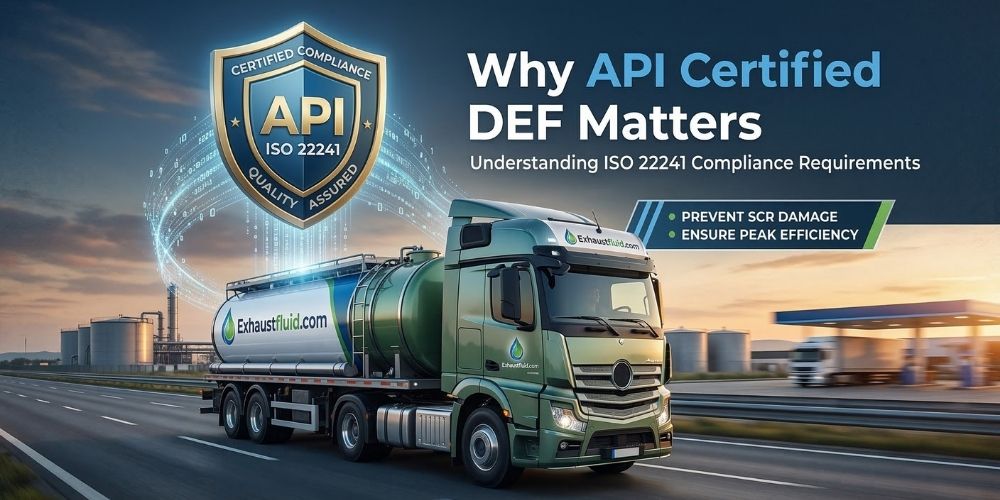
Not all DEF products meet the same standards. Choosing API certified DEF can mean the difference between reliable fleet performance and pricey SCR system failures. While the DEF standard requires a precise 32.5% urea concentration, most important quality differences exist based on ISO 22241 compliance, storage conditions and handling practices. Using contaminated or substandard DEF fluid ingredients introduces risks that extend way beyond the reach and influence of a dashboard warning light.
This piece will explain what ISO 22241 DEF certification defines and why API certification matters for protecting your SCR catalysts. We’ll also cover the specific DEF ingredients, purity standards and handling protocols that distinguish compliant products from those that put your fleet at risk. Understanding these standards becomes especially important when you have operations requiring nationwide DEF delivery.
What ISO 22241 DEF Standard Defines
The ISO 22241 standard establishes the international measure for DEF ingredients and quality control throughout the supply chain. This multi-part specification governs chemical composition, production equipment, storage containers and refilling interfaces. What this DEF standard defines helps fleet operators identify compliant suppliers and avoid products that compromise SCR performance.
DEF Composition Requirements: 32.5% Urea Concentration
ISO 22241 DEF mandates a urea concentration between 31.8% and 33.2% by mass fraction, with a target value of 32.5%. This precise ratio combines 32.5% pure urea with 67.5% deionized water. The standard requires testing at each stage of the distribution process, whether DEF fluid ingredients move through 275-gallon intermediate bulk containers, 55-gallon drums or retail-sized containers.
This specific concentration serves three critical functions. It produces the lowest freezing point of any urea-water mixture at 12°F (-11°C). The 32.5% concentration prevents urea deposition during long-term storage, whereas higher concentrations cause crystallization at the bottom of tanks. This ratio provides sufficient urea to convert NOx emissions and supports reliable SCR operation. The solution expands by up to 7% at the time of freezing but returns to full effectiveness after thawing without leaving solids or changing concentration.
Impurity Limits and Quality Characteristics
ISO 22241 establishes contamination thresholds that distinguish API certified DEF from substandard products. The standard limits biuret to ≤0.3%, aldehydes to ≤5 mg/kg and alkalinity (as NH3) to ≤0.2%. Metal contamination receives attention given that even trace amounts damage SCR catalysts. Copper and zinc must not exceed 0.2 mg/kg each, while iron, calcium, magnesium, sodium, potassium and aluminum face limits of 0.5 mg/kg. Phosphate content cannot surpass 0.5 mg/kg. Insoluble matter must remain below 20 mg/kg. Water must undergo deionization, ultra-filtration, reverse osmosis or single distillation to eliminate inorganic, organic and colloidal impurities.
Handling, Storage, and Transportation Guidelines
ISO 22241-3 specifies that all equipment contacting DEF must use compatible materials. Approved options include high-grade stainless steel (AISI 316L), high-density polyethylene (HDPE), polypropylene and PTFE. Copper-based materials accelerate contamination and must be avoided. Storage temperature affects shelf life: DEF maintains quality for 36 months at ≤10°C, 18 months at ≤25°C, 12 months at ≤30°C and only 6 months at ≤35°C. Prolonged storage above 30°C should be avoided to prevent urea decomposition and water evaporation. All surfaces must be cleaned with distilled or deionized water before DEF contact, as tap water introduces harmful alkali and alkali earth metal ions.
Why API Certified DEF Matters for SCR Systems
How Poor Quality DEF Damages SCR Catalysts
SCR systems require high-purity DEF because even trace contaminants trigger damage at very low concentrations. Non-API-certified DEF often contains impurities like aldehydes or biuret that attack SCR catalysts. Common contamination sources include diesel fuel, engine oil, and coolant. Crystallization deposits block DEF injectors and cause incomplete NOx reduction when contamination occurs. This triggers fault codes such as P20EE and P207F. The alkalinity of DEF (pH 7.0-9.5) corrodes aluminum, brass, and copper in fuel systems. Leaks and electrical failures follow. Therefore, poor quality DEF ranks among the top causes of SCR repair needs in modern diesel engines.
The Cost of DEF-Related Engine Failures
Contaminated DEF forces engines into limp mode with reduced power states to limit emissions. Fleet operations face downtime costs ranging from $800 to $15,000 per day in lost revenue. Complete tank drainage, line flushing, and injector replacement can reach thousands of dollars per vehicle. SCR catalyst replacement costs $5,000 to $15,000 per repair. DEF contamination in diesel fuel necessitates full fuel system replacement costing upwards of $3,000 for SCR units alone. Conversely, ignoring DEF quality guides to inaccurate diagnostics. Technicians replace sensors or components when the root cause is contaminated fluid. This results in unnecessary parts replacements and wasted labor.
API Certification vs. Non-Certified Products
The API Diesel Exhaust Fluid Certification Program certifies and monitors brands intended for SCR converters in motor vehicles, marine, rail, and stationary applications. API-licensed DEF undergoes random field testing where samples are purchased and analyzed. API can suspend or terminate licensing authority and require marketplace removal of noncomplying products if they fail to meet ISO 22241 technical specifications.
Real-Life Audit Results: 96% Compliance Rate
API’s monitoring program attempts to secure samples of all licensed brands each year. About 500 diesel exhaust fluid samples were tested in 2021 alone. For DEF tank monitoring and bulk DEF quote requests, verify supplier certification status first.
ISO 22241 Compliance Requirements Breakdown
ISO 22241 consists of five interconnected parts that establish DEF quality from production through vehicle refilling. Each part addresses everything in the supply chain to maintain fluid integrity.
Part 1: DEF Fluid Ingredients and Quality Standards
Part 1 defines quality characteristics that manufacturers must monitor continuously and follow a production control plan. The standard specifies test methods in Table 1 as referee methods during disputes. Retail distribution pumps and containers must carry the AUS 32 designation mark.
Part 2: Laboratory Test Methods to Verify
Part 2 outlines testing methods to confirm chemical composition and purity. Parameters tested include urea concentration, density at 20°C, refractive index, alkalinity, biuret, aldehydes, insoluble matter, phosphate, and metals. Production machinery must support easy sampling and lab integration.
Part 3: Materials Compatibility and Equipment Standards
Part 3 specifies that materials contacting DEF during handling, transportation, and storage must resist contamination and corrosion. Testing should reflect intended temperature ranges and contact times to assess quality impacts.
Part 4: Refilling Interface Requirements
Part 4 establishes minimum functional and geometric requirements for open refilling systems to ensure compatibility between on-board and off-board systems. These specifications apply to commercial vehicles and busses exceeding 3.5 tons gross vehicle mass.
Shelf Life Requirements Based on Storage Temperature
Constant ambient storage temperature determines minimum shelf life: 36 months at ≤10°C, 18 months at ≤25°C, 12 months at ≤30°C, and 6 months at ≤35°C. Storage above 35°C requires batch testing before use.
How to Verify Your DEF Supplier Meets ISO 22241
Verification starts with a look at the product packaging. Confirm your supplier’s containers display the official certification mark measuring at least 2.5 cm by 2.5 cm. This mark should appear on the front of every container, whether you purchase retail bottles or dispense from bulk storage. Check expiration dates on all packaging, as shelf life varies based on storage conditions.
Check for API Certification Mark on Packaging
Search the API licensee directory and confirm your supplier holds active certification. Request the customer sales receipt showing manufacturer and brand information at dispensing pumps. Many states mandate this disclosure for bulk DEF transactions.
Request Certificate of Analysis Documentation
Suppliers must provide a Certificate of Analysis with every shipment that addresses all ISO 22241 quality characteristics. This document should include manufacturer contact details, product name, batch number, date of release, expiry date, each test performed with acceptance limits and numerical results. Quality unit personnel must date and sign each COA before release.
Inspect Batch Codes and Traceability Information
Each container requires legible and durable product traceability codes. These codes permit traceability by formulation, packaging date and manufacturing source. Batch codes contain information about when, where and how the product was made. Brands can isolate affected inventory during quality issues without halting full production.
Assess Storage and Dispensing Equipment
Inspect whether storage tanks and dispensing equipment use dedicated systems that are cleaned following proper protocols to avoid cross-contamination. Request details on DEF delivery near me and bulk handling procedures.
Questions to Ask Your Bulk DEF Supplier
Besides certification status, ask suppliers about their quality control testing frequency, storage temperature monitoring systems and equipment cleaning protocols. Request information on how they handle product traceability and whether they maintain records linking each delivery to specific production batches. Contact us for a bulk DEF quote with full certification documentation for operations that require consistent supply.
Conclusion
Your fleet needs protection from SCR failures that can get pricey. API certified DEF will give ISO 22241 compliance and prevent catalyst replacements costing $5,000-$15,000 plus operational downtime that contaminated products cause. Verify certification marks and assess supplier storage protocols before you commit to any DEF source. Quality verification takes minutes but saves thousands in repair costs and keeps your fleet running.
Key Takeaways
Understanding ISO 22241 compliance and API certification is crucial for protecting your fleet from expensive SCR system failures and ensuring reliable diesel engine performance.
• API certified DEF prevents costly repairs: Non-compliant DEF causes SCR catalyst damage costing $5,000-$15,000 per replacement, plus downtime costs up to $15,000 daily.
• Precise 32.5% urea concentration is critical: ISO 22241 requires exact urea-to-water ratios between 31.8%-33.2% to prevent crystallization and ensure optimal NOx reduction.
• Storage temperature directly impacts shelf life: DEF lasts 36 months at ≤10°C but only 6 months at ≤35°C, making proper storage essential for maintaining quality.
• Verify suppliers through API certification marks: Check for official 2.5cm certification marks on packaging and request Certificates of Analysis to confirm ISO 22241 compliance.
• Material compatibility prevents contamination: Only use HDPE, stainless steel (316L), or polypropylene equipment – avoid copper-based materials that accelerate DEF degradation.
The difference between compliant and non-compliant DEF isn’t just about meeting regulations—it’s about protecting your investment and maintaining fleet reliability through proper quality verification.
FAQs
Q1. What does API certification mean for diesel exhaust fluid? API certification is a voluntary quality program that verifies diesel exhaust fluid meets ISO 22241 standards through regular testing and monitoring. API-certified DEF undergoes random field sampling and laboratory analysis to ensure it contains the proper 32.5% urea concentration and meets strict purity limits for contaminants like metals, biuret, and aldehydes.
Q2. Which international standard governs DEF quality requirements? ISO 22241 is the international standard that establishes quality requirements for diesel exhaust fluid. This multi-part specification covers chemical composition, laboratory test methods, materials compatibility, storage guidelines, and refilling interface requirements to ensure DEF protects SCR systems from damage.
Q3. Why is the exact 32.5% urea concentration important in DEF? The 32.5% urea concentration (ranging from 31.8% to 33.2%) serves three critical purposes: it creates the lowest freezing point at 12°F, prevents urea crystallization during storage, and provides sufficient urea for effective NOx emission conversion. This precise ratio ensures reliable SCR system operation across varying temperature conditions.
Q4. How does storage temperature affect DEF shelf life? Storage temperature directly determines how long DEF maintains its quality. When stored at temperatures at or below 10°C (50°F), DEF lasts 36 months. At 25°C (77°F) or below, shelf life reduces to 18 months. At 30°C (86°F), it drops to 12 months, and at 35°C (95°F), DEF only remains viable for 6 months.
Q5. What materials are safe for DEF storage and handling equipment? Only specific materials should contact DEF to prevent contamination. Approved materials include high-density polyethylene (HDPE), polypropylene, PTFE, and high-grade stainless steel (particularly AISI 316L). Copper-based materials must be completely avoided as they accelerate DEF degradation and introduce harmful contaminants that damage SCR catalysts.